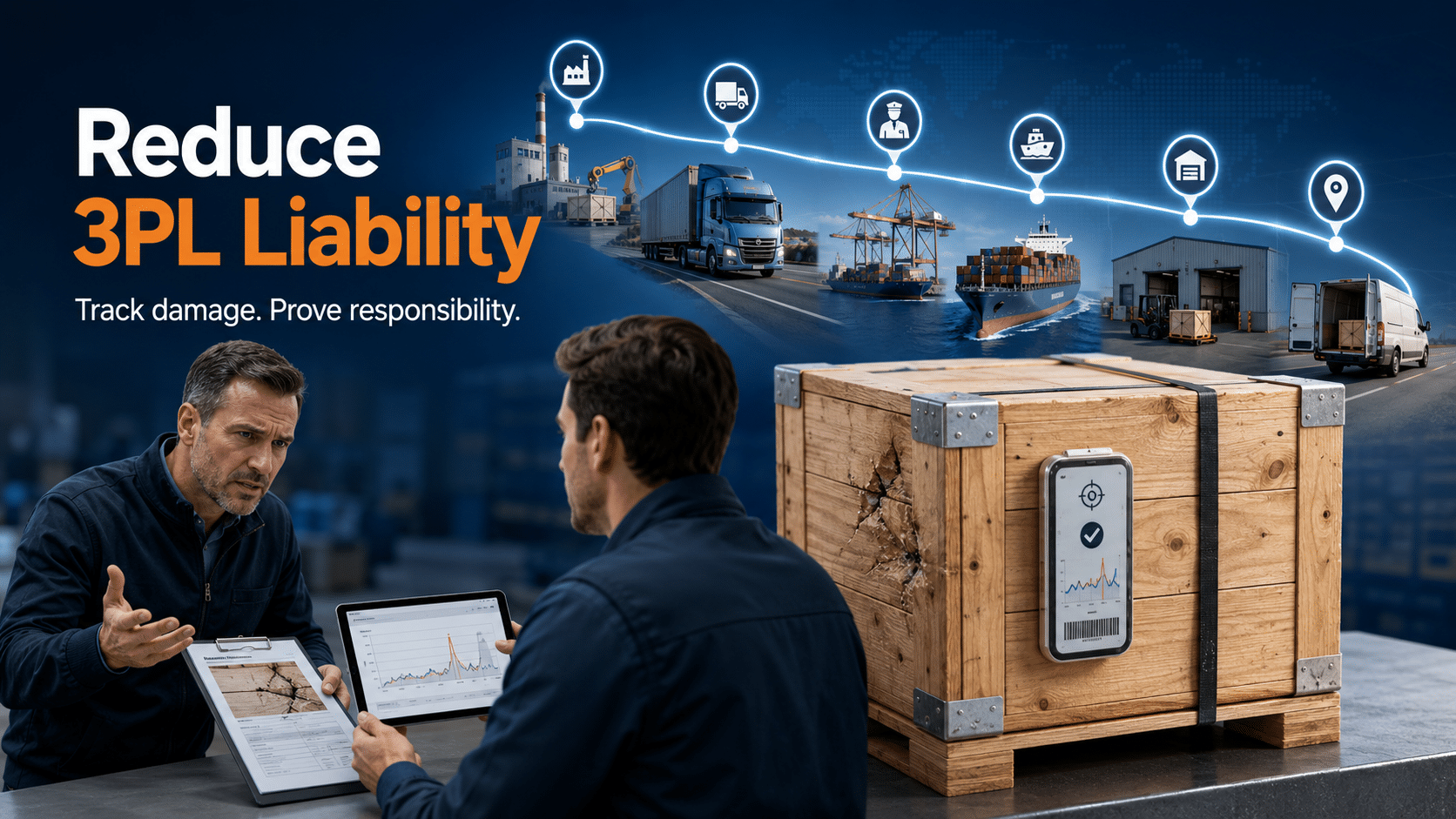
Achieving 3PL liability reduction is the most critical survival strategy for modern logistics companies facing unfair compensation demands today. In the complex global supply chain, a single high-value shipment will pass through multiple touchpoints. It moves from the original manufacturer, onto a truck, through customs, into an ocean container, and finally to a cross-docking warehouse.
However, when the end customer opens the box and finds a broken machine, they do not blame the ocean carrier or the customs officer. They immediately blame the last-mile delivery provider. This results in a massive, unfair freight forwarder cargo damage claim.
Third-party logistics (3PL) providers and freight forwarders are constantly forced to pay out of their own pockets for damage they did not cause. To survive in this low-margin industry, you must stop relying on outdated inspection methods. You need a proactive strategy to secure undeniable transit data, draw a clear line of responsibility, and permanently eliminate upstream damage liabilities.
The “Blind Spot” in Standard Proof of Delivery Transit Damage
For decades, logistics drivers and warehouse receivers have relied on a very simple method for protection: the visual inspection. When picking up a shipment, the driver takes a photograph of the external cardboard box or wooden crate. If the outside looks perfect, they sign the standard Proof of Delivery (POD) document.
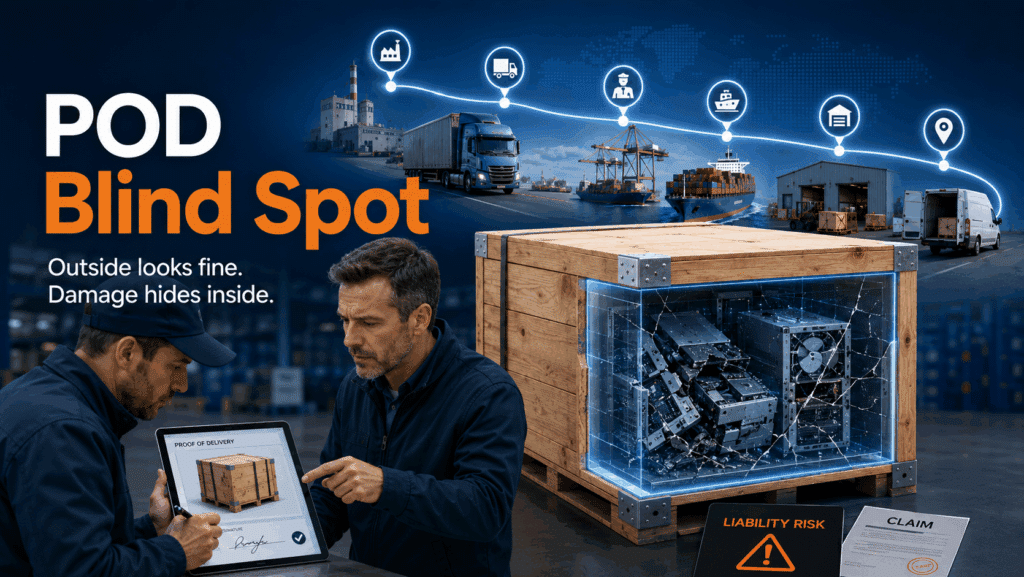
Unfortunately, this traditional method contains a massive blind spot regarding proof of delivery transit damage. Taking a photo of the outside box does absolutely nothing to prove the condition of the sensitive equipment inside.
This issue is called “Concealed Damage.” When shipping million-dollar semiconductor equipment, medical devices, or heavy servers, the external packaging might be incredibly strong and show zero physical dents. However, during an upstream ocean journey or a rough customs inspection, the crate might have been dropped heavily. The internal microchips are shattered, but the outside looks perfect.
Because the last-mile 3PL signed the clean POD, the legal liability instantly transfers to them. Without digital evidence, the 3PL cannot prove the drop happened before they took possession. They are trapped in a dead-end freight forwarder cargo damage claim. You must protect 3PL from false damage claims by using technology that looks inside the box.
How a Shock Indicator Label for Logistics Providers Offers Absolute Protection
The most effective way to achieve immediate 3PL liability reduction is to use a physical monitoring tool that travels with the cargo. This is where WAN-YO’s Impact Indicator 2 comes in.
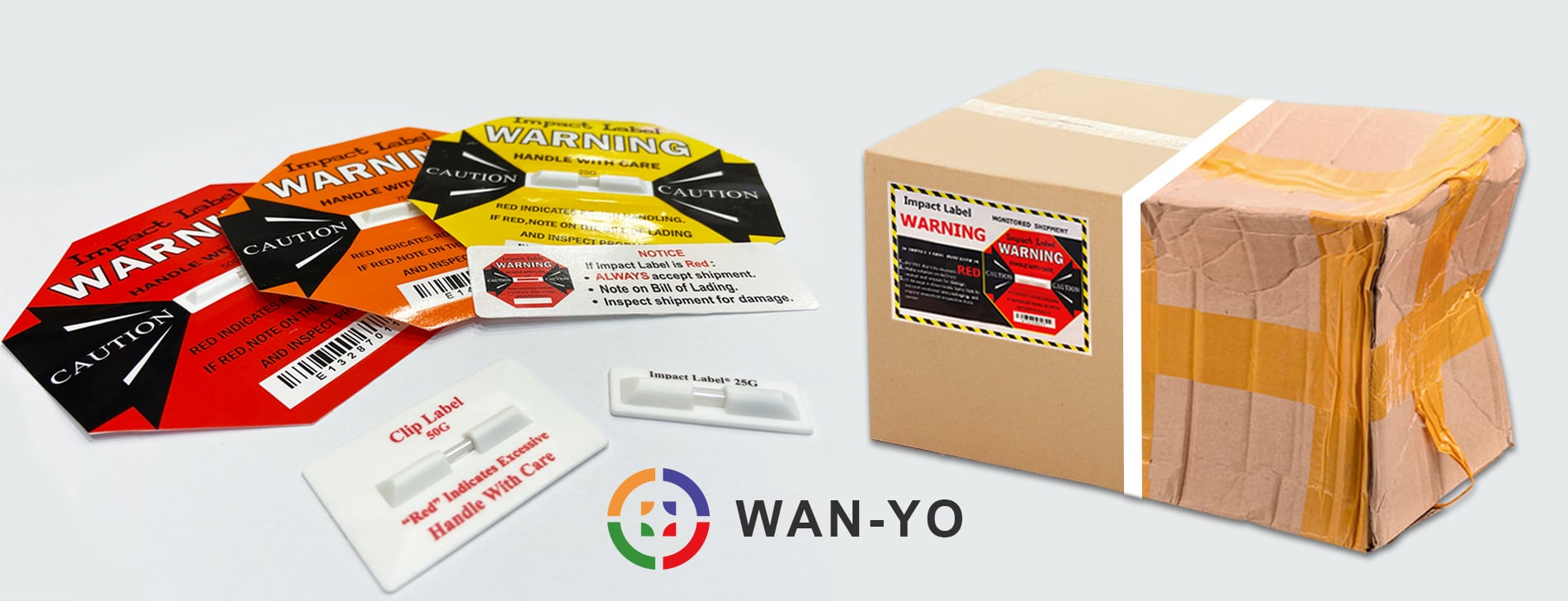
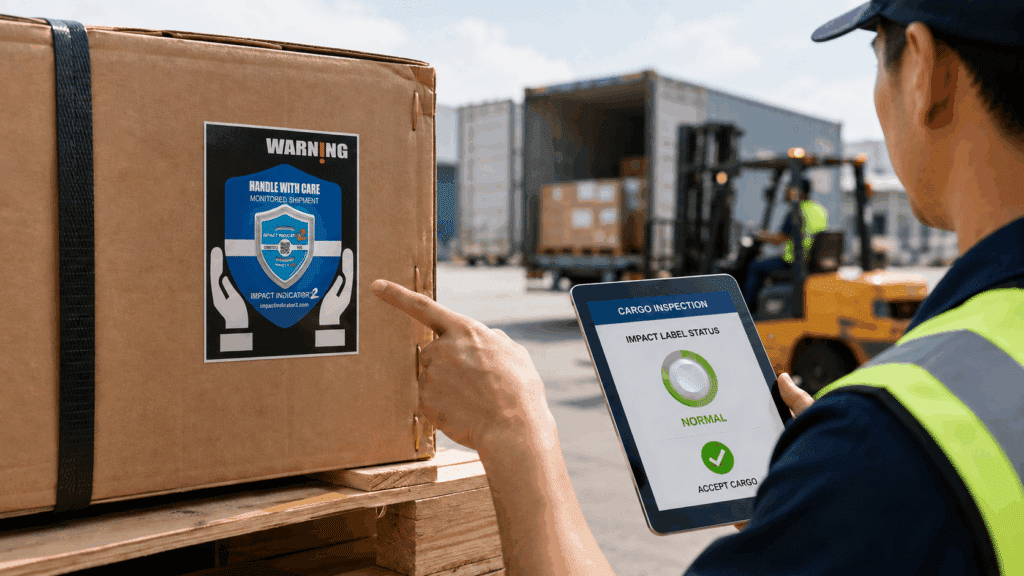
A shock indicator label for logistics providers is a highly visible, tamper-proof device applied directly to the packaging. It contains a highly engineered liquid or mechanical component that instantly turns bright red if the cargo is dropped or experiences an impact beyond a specific G-force threshold (such as 25G or 50G).
This simple label completely changes the legal dynamics of cargo transfer. It is not a tool to spy on your drivers; it is a permanent shield to protect your business margin.
When your logistics team arrives at a port, airport, or upstream warehouse to pick up a pallet, they simply look at the WAN-YO Impact Indicator 2.
-
If the label is normal, they accept the cargo safely.
-
If the label is already red, your team immediately refuses the shipment or marks “Exception/Damaged Before Pickup” on the digital POD.
By identifying the shock event right at the handover point, you draw an absolute line of responsibility. You instantly prove that the damage occurred upstream. This completely shields your company from the incoming freight forwarder cargo damage claim.
Turn Defense into Profit: The “VIP Secure Transit” Value-Add
Smart 3PL business owners know that a shock indicator label for logistics providers is not just a defensive tool. It is a powerful weapon to increase your corporate revenue and win high-value contracts.
Instead of secretly using these labels just to protect yourself, you can actively sell “Cargo Monitoring” as a premium, value-added service to your customers.
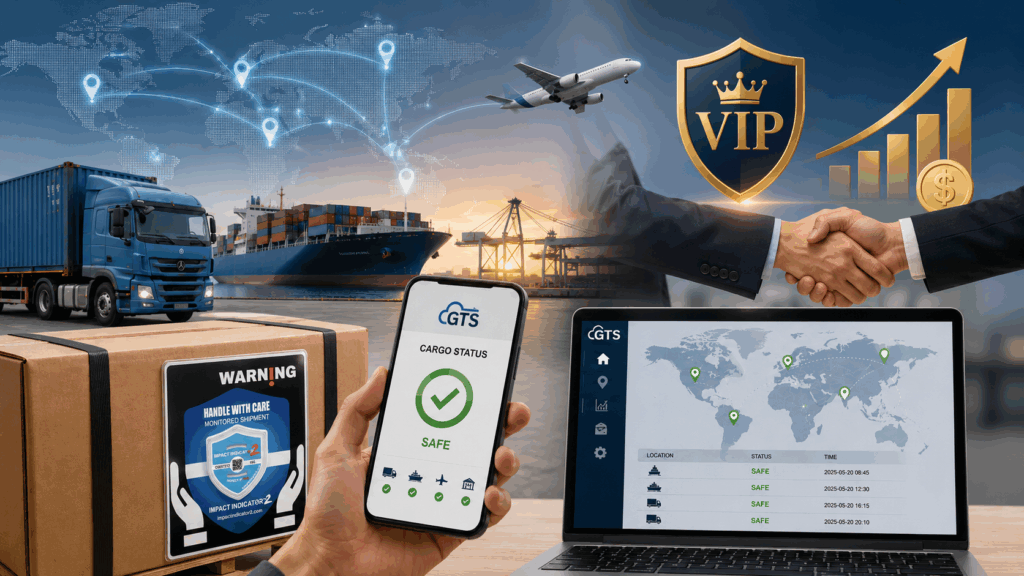
WAN-YO makes this incredibly easy and highly profitable by providing our proprietary Goods Tracking System (GTS). The GTS is a cloud-based logistics tracking platform that is 100% free of charge for every user. There are no software subscription fees, no “Pro” version limits, and no hidden infrastructure costs (Zero CAPEX).
You can offer a “VIP Secure Transit” package to manufacturers shipping expensive equipment. Your marketing pitch becomes very strong: “Unlike standard logistics companies, we provide end-to-end digital visibility. Our team will scan the WAN-YO QR code at every major transit hub. You can log into our free GTS cloud and see the real-time safety status of your cargo anywhere in the world.”
This premium service allows you to charge a higher logistics freight rate. You easily cover the low cost of the Impact Indicator 2, increase your profit margin, and build massive customer loyalty—all while achieving total 3PL liability reduction.
A Proven SOP to Protect 3PL from False Damage Claims
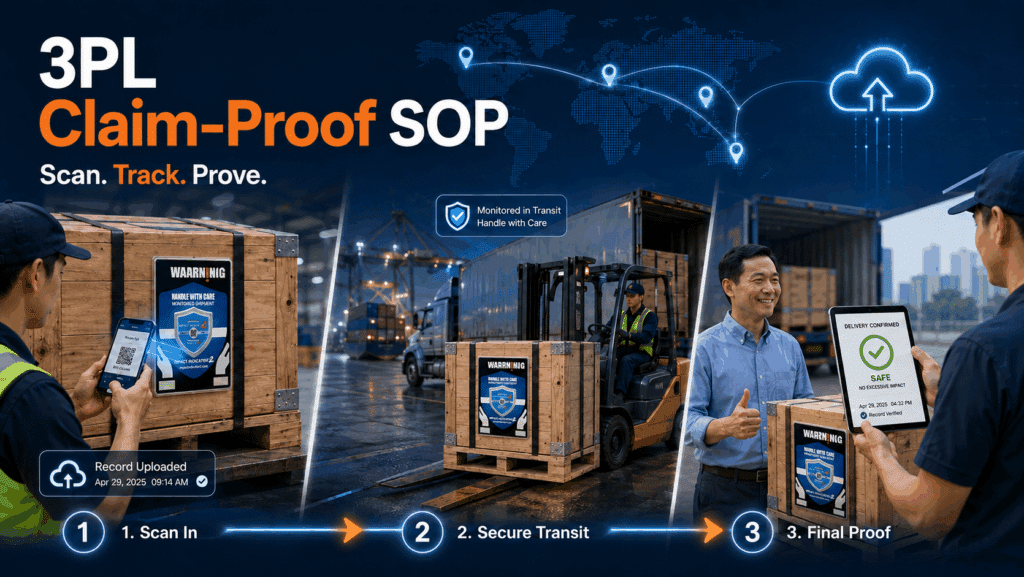
To guarantee success and eliminate every single freight forwarder cargo damage claim, your logistics management team must implement a strict Standard Operating Procedure (SOP). Follow these 3 easy steps to integrate WAN-YO solutions into your daily workflow:
Step 1: The Inbound Scan (Transfer of Liability) When receiving cargo from an upstream shipping line or a client’s factory, your warehouse staff must check the Impact Indicator 2. Using a standard smartphone, they scan the QR code on the label to upload the “Safe” or “Triggered” status directly to the free GTS cloud. This time-stamped digital record is your ultimate proof of delivery transit damage protection.
Step 2: The Secure Transit (Psychological Deterrent) As your trucks move the cargo, the bright red and yellow warning labels act as a strong psychological deterrent. Data shows that when warehouse workers and forklift drivers see these prominent labels, they naturally slow down and handle the pallets with much more care. This prevents your own team from causing accidental damage.
Step 3: The Liability-Free Handover When delivering to the final buyer, perform one last scan in front of the customer. You provide them with undeniable digital proof that the cargo was handled perfectly during your leg of the journey. If they open the box later and find a manufacturing defect, they cannot blame your logistics company. You successfully protect 3PL from false damage claims.
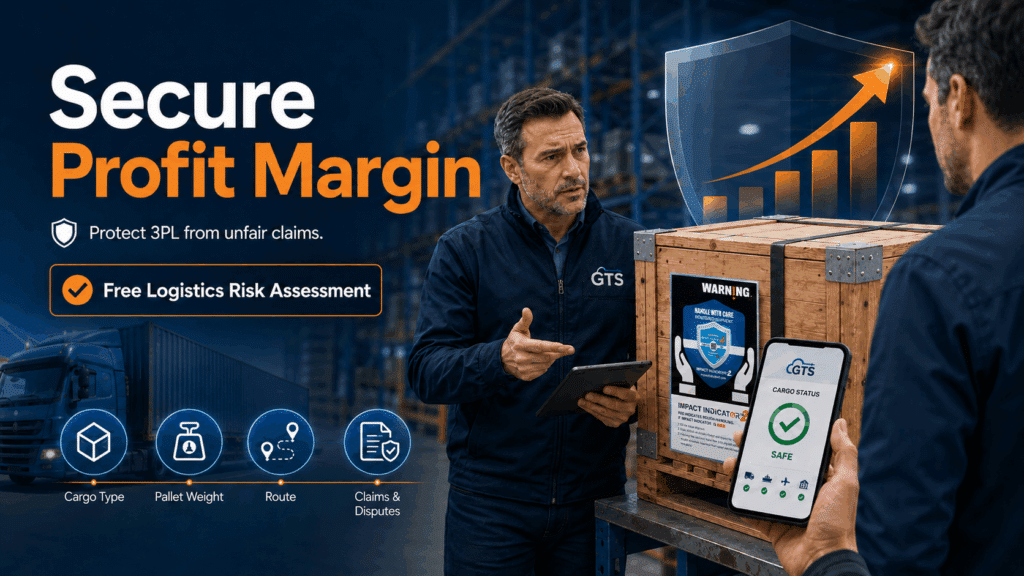
Secure Your Profit Margin. Get Your Free Logistics Risk Assessment Today!
Do not let upstream mistakes destroy your logistics profit margin. Stop paying out of your own pocket for every unfair freight forwarder cargo damage claim.
It is time to take control of your liability and upgrade your logistics business. Start utilizing the world’s most reliable impact indicators and our 100% free Goods Tracking System to protect your fleet today.
Simply tell us 4 basic details to get started:
-
Your typical cargo types (Electronics, medical, auto parts, etc.)
-
The average weight of your handled pallets
-
Your main logistics routes (Air freight, ocean, or domestic trucking)
-
Your current challenges with damage claims or insurance disputes
Our engineering and logistics security team will manually review your data. We will show you exactly how to achieve immediate 3PL liability reduction tailored to your specific operations.
FAQ for Freight Forwarders
Q1: Will applying these labels make my logistics service look bad to the shipper? No, it does the exact opposite. Global shippers respect 3PLs that take cargo security seriously. Using WAN-YO labels proves you are a professional, transparent logistics partner, which helps you win enterprise-level contracts.
Q2: How does the free GTS platform handle international cross-docking? The GTS platform is cloud-based and accessible globally. Whether your cargo is scanned by a partner in Germany, a port worker in India, or your delivery driver in the USA, the data is instantly centralized. This creates an unbroken chain of custody for excellent 3PL liability reduction.
Q3: What if the customer still files a freight forwarder cargo damage claim? If a customer tries to file a claim for concealed damage, you simply export the GTS scanning report. You present the time-stamped photos showing the label was perfectly intact at the time of delivery. This unalterable evidence stops the legal dispute immediately and forces the customer to look at manufacturing defects instead of blaming the logistics provider.